
Nationwide Survey: Americans Love AI, Just Not in Their Backyard
Public demands high-tech progress without any tangible inconvenience
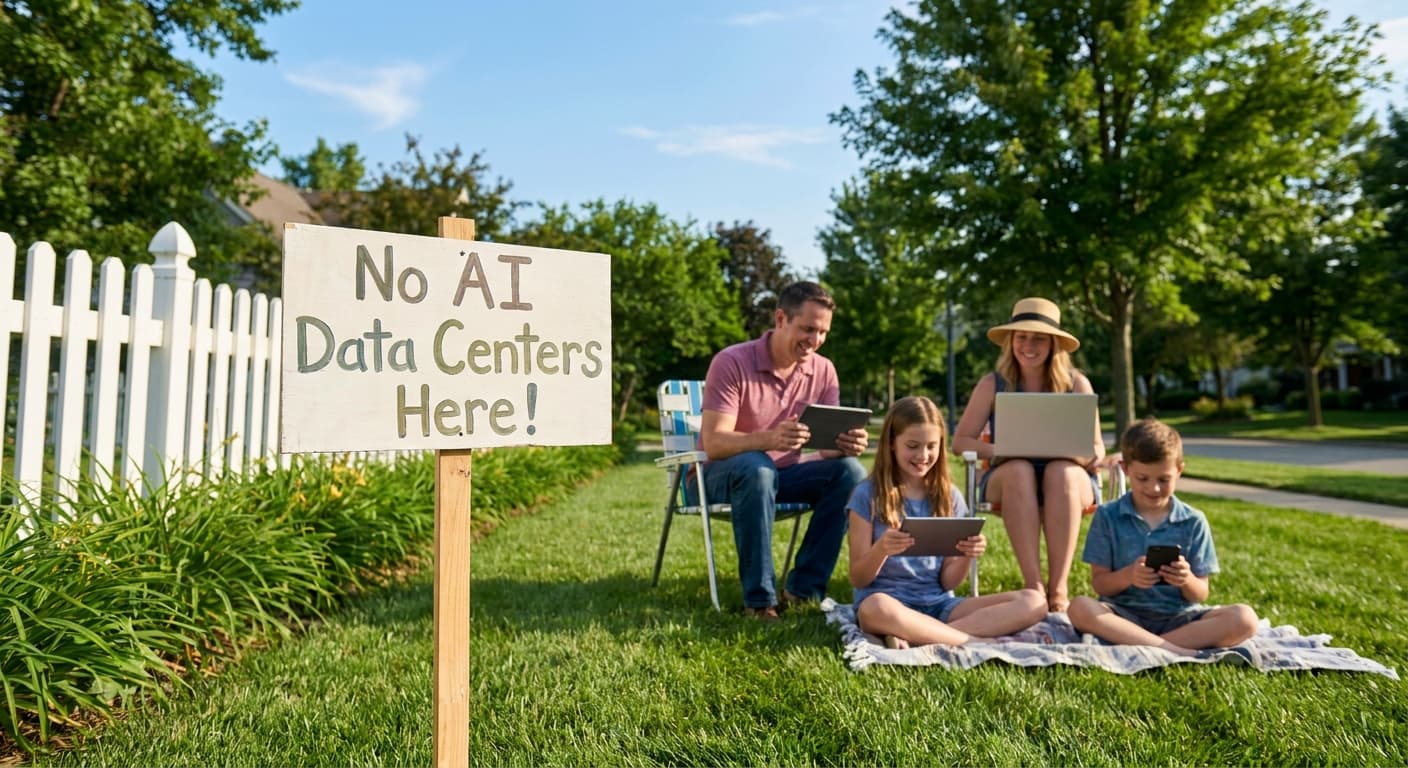
"Shouldn’t we consider Mars for these centers?" speculated Skylar Ramsey.
In an unprecedented display of collective cognitive dissonance, a new national poll reveals that 69% of Americans oppose the construction of AI data centers in their neighborhoods, yet vehemently refuse to part with their beloved chatbots. This burgeoning NIMBY (Not In My Backyard) movement seems poised to challenge both city planners and reality itself.
The poll, conducted by the fictional Institute for Tremendous Research, underscores a familiar sentiment among the populace: boundless enthusiasm for technological advances, provided they materialize somewhere out of sight, preferably in an unknown locale that lacks scenic vistas or historical significance.
"We absolutely need this technology to advance humanity," said local resident John Doe, while texting on his AI-driven virtual assistant. "But can't it just manifest in a town with, say, zero personal relevance to me? Maybe a place off the grid where no one hears the existential hum of progress?"
Despite the apparent contradiction, participants express desires for AI to continue evolving at breakneck speed, transforming everything from conversations to customer service. However, when questioned on the specifics of data center placement, responses ranged from creative geography suggestions to intricate arguments about the portability of the cloud.
"Shouldn’t we consider Mars for these centers?" speculated Skylar Ramsey, an AI enthusiast with a firm stance on the importance of local aesthetic integrity. "I hear there's a lot of space there." While interplanetary infrastructure remains a distant fantasy, researchers emphasize the need for terrestrial solutions.
Ironically, the same survey indicates that 85% of respondents believe that advancements in AI are as pivotal as achieving world peace. This juxtaposition has left municipal leaders scrambling to balance innovation with a geography that conveniently excludes their constituents' line of sight.
Urban planners are now tasked with the almost Sisyphean challenge of creating invisible data centers. Emerging proposals include subterranean complexes, camouflaged exteriors matching local fauna, or fittingly, holograms of forests that disguise buildings as lush woodlands.
As Americans continue to walk the fine line between relentless progress and whimsical detachment, AI may soon find itself with a paradoxical instruction: be everywhere, and nowhere simultaneously.
Break a Story
Write something reasonable.
Desk Notes: Deadpan Serious · Clearly Satirical · Column
Share or break your own story.