
Newly Identified Wild Cat in Bolivia Instructed to Stay by Its Placard
Enforcement facilitated by international scientific protocol
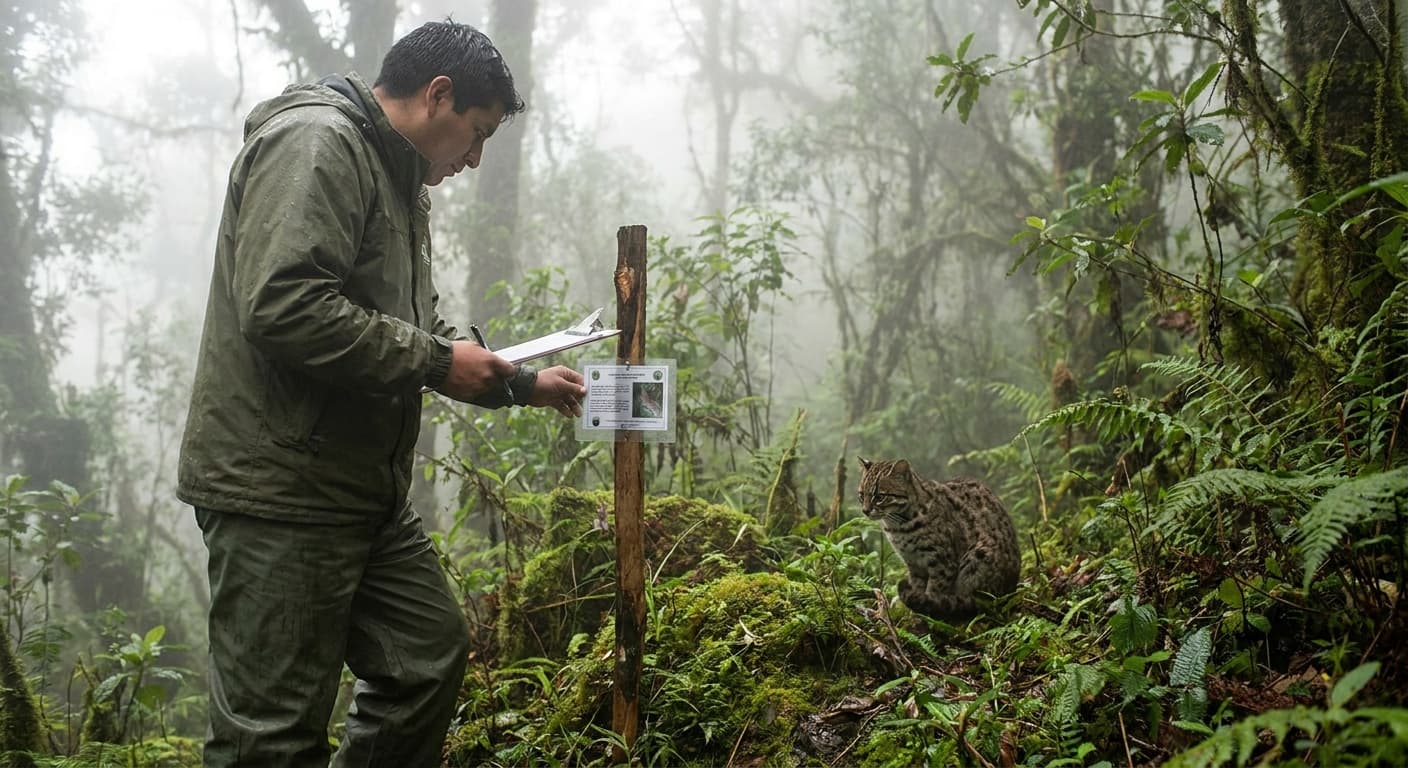
'Regulation compliance,' notes Santoro in his official log, 'is strictly observed every morning at precisely 0700 hours.'
The cloud forests of Bolivia have become the unlikely backdrop for a peculiar demonstration of international conservation practices, as scientists debut an unprecedented approach to cataloging a newly described wild cat species. Following established procedures by the International Code of Zoological Nomenclature (ICZN), a meticulously laminated species placard has been deployed via wooden stake, its location dictated precisely to within six feet of the animal itself.
The cat, which has yet to exhibit any signs of dissatisfaction with its new stationary existence, is under the vigilant eyes of local park rangers. Officer Emilio Santoro is tasked with the daily recording of the feline's position in relation to the placard, reporting any transgressions beyond a two-meter radius. "Regulation compliance," notes Santoro in his official log, "is strictly observed every morning at precisely 0700 hours."
In alignment with ICZN Article 72.5.6, the placard designates this precise spot as the site of the holotype specimen, now meticulously documented and preserved within Bolivia’s National Biodiversity Collection. The cat’s presence there is, apparently, critical for ongoing assessments by the IUCN Red List, which requires immediate occupancy data for new species classifications.
Controversy emerged when a CITES evaluation task force proposed its inclusion on Appendix II, sparking debates on whether the cat’s expected geographical range conflicts with the stake-ordained point of observation. "Occupancy criteria," experts stressed, "do not traditionally account for human-imposed geography."
In light of a shifting landscape and the potential for natural migration, peer-reviewed journals have published corrections when the stake, inadvertently moved by external forces, disrupts scientifically validated proximities. Each correction is painstakingly filed and cross-referenced with all agencies involved.
The procedure has inevitably drawn the attention of various ecological bodies and sparked conversations about whether the animal's coerced stasis might eventually necessitate a revision in the guidelines for valid species registration.
While the cat displays a notable tolerance for its limitations, whispers circulate among conservationists suggesting that perhaps nature should take precedence over nomenclatural dictates.
Break a Story
Write something reasonable.
Desk Notes: Deadpan Serious · Clearly Satirical · Column
Share or break your own story.