
Rome Reclassifies Tourist Golf Carts as Chariots, Implements Horse-Drawn Mandate
New decree reinstates equine transport in the Eternal City
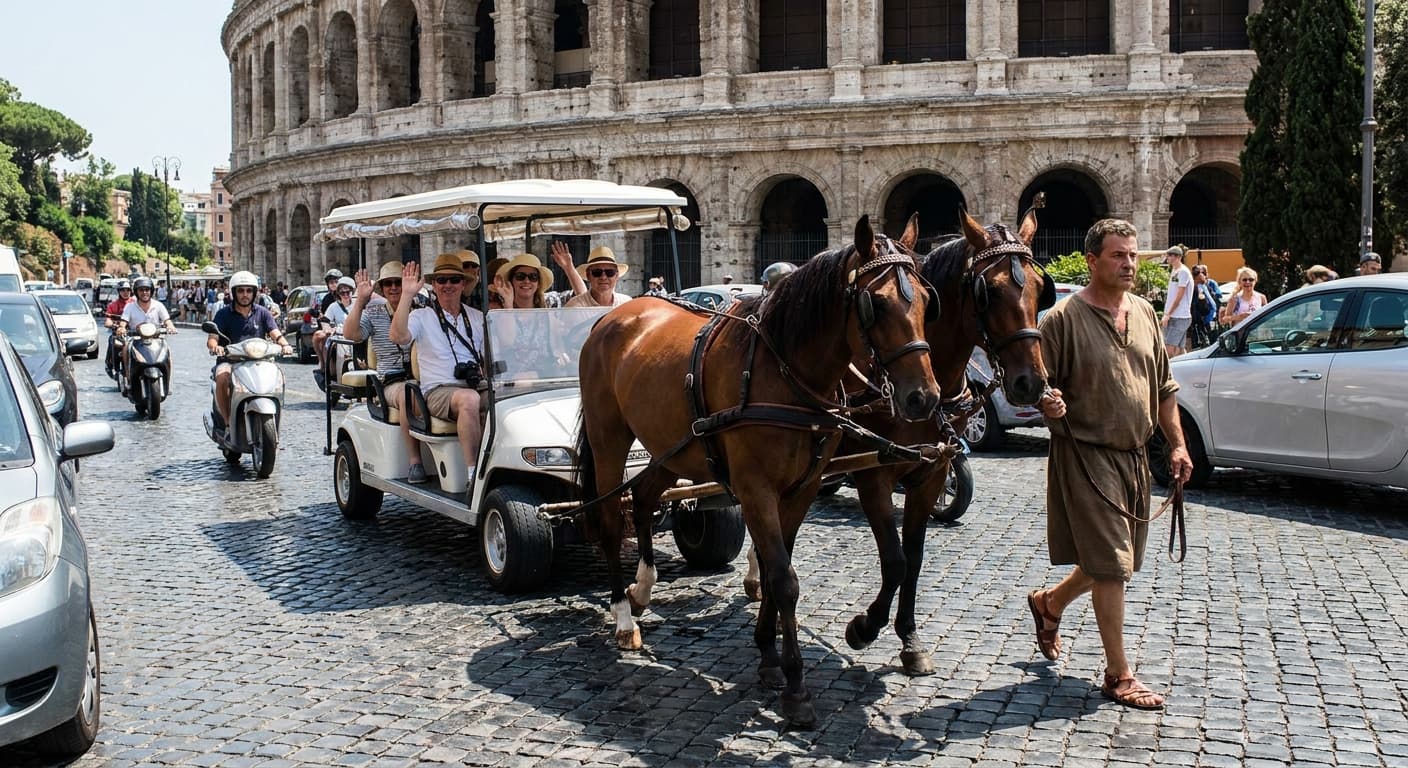
"The comune has established a comprehensive licensing program for charioteers."
In an unexpected decree this week, Rome has officially reclassified all tourist golf carts within its historic center as chariots. The directive, effective immediately, mandates that each vehicle must be drawn by a pair of horses, a decision rooted, officials say, in preserving the city's classical heritage.
The comune has already established a comprehensive licensing program for charioteers to ensure compliance with modern transport laws. To qualify, drivers must demonstrate proficiency in animal handling and undergo rigorous examinations, reflective of the city’s commitment to maintaining safety standards amidst this equestrian revival.
This reclassification aligns with existing European Union rules on animal transport, requiring that all horses used in this context be provided with daily rest periods and appropriate nourishment. Rome's decision has triggered a wave of interest across the continent, as other historic cities weigh the implications of adopting similar measures.
Moreover, the initiative has been met with varying responses from insurers who are now recalculating risk assessments for equine-related incidents. Italian insurers are particularly focused on adapting coverage policies to incorporate unforeseen variables, such as sudden horse detours due to environmental distractions, which were not calculable with motorized golf carts.
Within the boundaries of the UNESCO buffer zone surrounding the city's archaeological treasures, specific restrictions have been introduced to mitigate potential impacts on ancient structures. These include designated routes and speed limits to reduce vibrations caused by hooves on cobblestones.
On a national level, the Italian government is considering whether a standard horse-to-cart ratio should be established. The Ministry of Cultural Heritage sees this as a potential tourist draw, promising an authentic experience of navigating ancient sites as Romans once did.
In acknowledgment of these developments, the European Commission has expressed interest in studying Rome as a model for integrating historical preservation with contemporary tourism strategies. While this approach marks a distinct shift from typical urban planning methods, Rome insists that blending tradition with modern regulation is crucial for the survival of its unique identity.
Break a Story
Write something reasonable.
Desk Notes: Deadpan Serious · Clearly Satirical · Column
Share or break your own story.