
White House Briefing Now Exclusive to Telescope-Toting Journalists
Press Conferences Relocated to Extralongitudinal Grounds
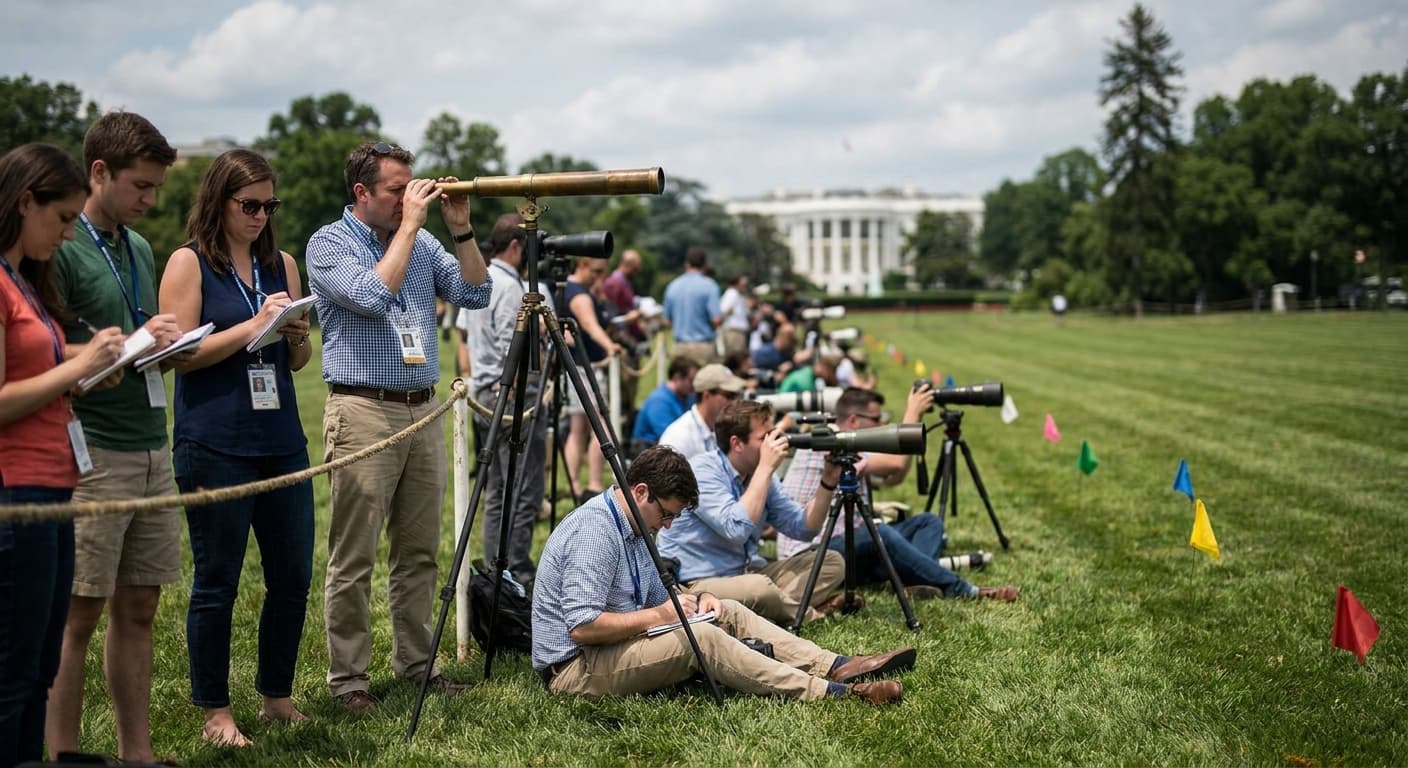
"It's about how far you can see from where you’re seated."
In a groundbreaking move redefining media access, the White House has officially relocated its press briefings to a designated area on the South Lawn, requiring journalists to observe events through telescopes from a calculated minimum distance of 400 yards. The change, heralded as a marvel of modern logistical strategy, has been enthusiastically endorsed by the new Bureau for Enhanced Diplomatic Distance (BEDD).
Reporters who formerly navigated the complexities of the White House Press Room now find themselves organized into tiered credential classes. Class One journalists, equipped with high-powered telescopes, occupy premium locations near the topiary elephants, while Class Two reporters are granted lawn chairs slightly closer to the perimeter. Class Three occupies what is affectionately referred to as "the no-peeking zone," where low-visibility binoculars are the norm.
The General Services Administration, instrumental in overseeing lawn installations, has provided detailed seating charts to ensure an equitable distribution of viewing advantage. "It's not just about who you write for," noted the head of External Seating Operations, "it’s about how far you can see from where you’re seated."
The International Telescope and Geometrical Optics Committee (ITGOC) will be on hand to verify compliance with visual standards, ensuring that all participating media are operating within the prescribed focal range. This global collaboration marks a significant milestone in international journalistic practice, emphasizing accuracy at a comforting distance.
In an unexpected show of unity, major news outlets have formed the Association of Distant Correspondents, vowing to uphold traditional reporting values while embracing the modern demands of remote engagement. Members are actively lobbying for the addition of a refreshment cart at the mid-range marker, a crucial resource for maintaining professional stamina.
Government officials have praised the new arrangement as "an innovative adaptation to contemporary media challenges," asserting that telescopic coverage could potentially open new realms of speculative reporting, turning the art of observation into a visionary exercise.
While skepticism remains over who benefits most from this visual relocation, the enthusiasm for enhanced techno-journalistic tools seems to have taken the media world by storm. The Press Secretary, seen as a distant blur in recent broadcasts, confidently assures that "this is just the beginning of seeing things from a new perspective."
As political analysis inadvertently shifts to astronomic assessments, the future of journalism from afar appears both deeply unclear and profoundly farsighted.
Break a Story
Write something reasonable.
Desk Notes: Deadpan Serious · Clearly Satirical · Column
Share or break your own story.